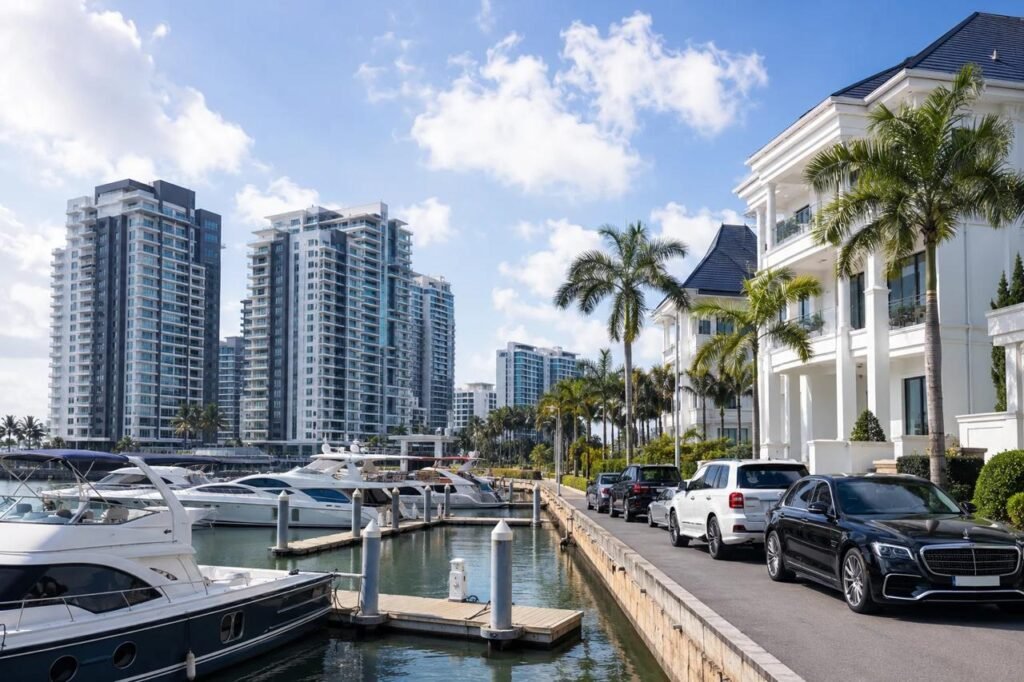
Rental yields in Lagos in 2026 range from 3–5% in prime Island neighbourhoods like Ikoyi and Banana Island to 7–9% on the Mainland in areas like Yaba and Maryland — making location the single most important variable for property investors in 2026.
Understanding where your money works hardest requires more than a postcode. This guide breaks down gross rental yields across Lagos’s key investment zones, explains what’s driving the gaps, and highlights the emerging corridors that are shifting the calculus for yield-focused buyers.
Table of Contents
What Are Rental Yields and Why Do They Vary So Much in Lagos?
Gross rental yield is simply your annual rent income divided by the purchase price of a property, expressed as a percentage. A ₦10 million annual rent on a ₦100 million property gives you a 10% gross yield.
In Lagos, that number swings wildly by neighbourhood — not because rents differ dramatically, but because purchase prices do. Speculative demand has pushed property values in Ikoyi and Banana Island far above what rental income can justify, compressing yields. Meanwhile, Mainland areas like Yaba have benefited from strong organic rental demand from tech workers and young professionals, without the same price inflation on the buy side.
The result: buying cheap and renting steady beats buying prestigious and renting premium — at least for pure yield investors.
Lagos Rental Yields by Location (2026)
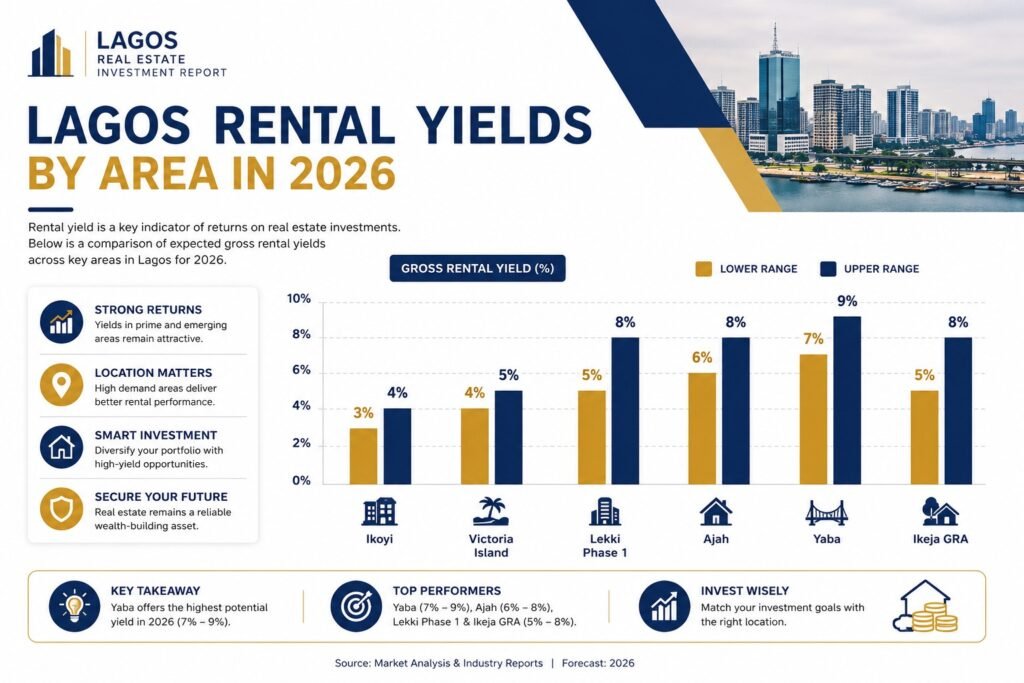
Premium Island: Ikoyi, Banana Island, Old Victoria Island
Gross yields: 3.0% – 5.0%
These are Lagos’s trophy addresses. Banana Island tops the city’s rent table at around ₦2.5 million per month, and Ikoyi commands ₦1.5 million monthly for well-appointed apartments. But purchase prices have run well ahead of those rents. According to Knight Frank’s Lagos Market Update and data from Nigeria Property Centre, sale prices in these enclaves frequently exceed ₦500 million for premium units, meaning yields for luxury apartments are compressed to just 3–4%.
That said, prime Island assets remain compelling for capital appreciation investors. Ikoyi, Victoria Island, and Lekki are currently experiencing the fastest growth in real estate value in Lagos, driven by infrastructure development and sustained expatriate and corporate demand. The trade-off is clear: low income yield today, higher resale potential tomorrow.
Best for: High-net-worth investors prioritising capital growth over rental income; investors targeting short-let conversion (furnished short-lets in this corridor can push gross yields to 10–15%).
Lekki Phase 1 and Inner Lekki (Osapa London, Ikate-Elegushi)
Gross yields: 5.0% – 8.0%
Lekki Phase 1 sits at the intersection of lifestyle and investment. Rents for mid-tier 2-bedroom apartments run ₦800,000–₦2.5 million per year, and the entry price for quality stock — while not cheap — is meaningfully below Ikoyi levels. According to The Africanvestor’s 2026 rental yield data, inner Lekki neighbourhoods like Osapa London and Ikate-Elegushi consistently deliver 5–8% gross yields.
Lekki benefits from the ongoing expansion of the Lekki Deep Sea Port and its proximity to Eko Atlantic City, where gross yields are currently estimated at around 6.5%. The corridor is also a major short-let hub: Lekki Phase 1 is among Lagos’s top Airbnb-listed neighbourhoods, allowing active investors to significantly outperform long-let benchmarks.
The balance of income yield, capital appreciation potential, and liquidity makes Lekki Phase 1 the most versatile investment zone in Lagos for the widest range of investor profiles.
Best for: Mid-to-high-net-worth investors seeking a blend of yield and appreciation; short-let operators; investors targeting 2-bedroom units (currently the city’s highest-yielding unit type).
Ajah and the Lekki-Epe Corridor
Gross yields: 6.0% – 8.0%+
Ajah is the story of Lagos property in 2026. Once considered a fringe location, it has matured into a credible investment zone driven by population overflow from Lekki, improved road infrastructure, and proximity to the Lekki-Epe Expressway. Properties in Ajah offer yields comparable to — and in some cases ahead of — mid-Lekki, at lower entry prices.
The Lekki-Epe corridor as a whole is being repositioned by two infrastructure catalysts: the anticipated Fourth Mainland Bridge and the Lagos-Calabar Coastal Highway (Section 1 of which opened in 2025). Properties within 5km of the coastal highway route are already seeing price appreciation of 25–40%, according to data from Troloppe Property Services.
Ibeju-Lekki, the outermost node of this corridor, is registering land appreciation of a similar magnitude, though it remains higher-risk due to a thinner rental market.
Best for: Growth-oriented investors willing to accept slightly lower near-term liquidity in exchange for above-market yield now and significant capital upside as infrastructure matures.
Mainland Mid-Tier: Yaba, Surulere, Maryland, Gbagada
Gross yields: 7.0% – 9.0%
Yaba is Lagos’s highest-yielding investment zone for residential property in 2026, consistently delivering 6–9% gross yields on well-placed 1 and 2-bedroom apartments. The driver is structural: Yaba hosts Lagos’s largest concentration of tech companies, co-working spaces, and universities, generating persistent rental demand from young professionals who cannot afford Island prices but refuse Outer Mainland inconvenience.
Two- to three-bedroom apartments in Yaba and Ikeja offer the highest risk-adjusted returns in the city, with occupancy rates of 85–90% and time-to-let averaging 4–9 weeks for correctly-priced units. Surulere, Maryland, and Gbagada deliver similar dynamics with a broader family-oriented tenant base.
The Red Line rail corridor — serving Yaba, Ikeja, and Oshodi — is accelerating Mainland investment, making the commute economics for tenants increasingly competitive with Island living.
Best for: Yield-focused investors, first-time property investors, portfolio builders seeking cash-flowing assets without Island entry costs.
Ikeja GRA and Ogudu/Magodo
Gross yields: 5.0% – 8.0%
Ikeja GRA sits in a sweet spot: it carries the prestige of a government-reserved area with purchase prices that have not been driven to Ikoyi levels. Ogudu GRA and Magodo Phase 2 mirror this dynamic. Both zones deliver 5–8% gross yields and attract a stable professional and expatriate tenant base.
Proximity to the Murtala Muhammed International Airport makes Ikeja GRA particularly attractive for corporate short-let, where furnished apartments near the airport consistently outperform long-let yields.
Best for: Investors seeking reliable tenancy with relatively low void risk; corporate short-let operators.
The Yield-Versus-Appreciation Trade-Off: A Quick Framework
| Zone | Gross Yield | Capital Growth Outlook | Best Strategy |
| Banana Island / Ikoyi | 3 – 4% | High | Capital appreciation / short-let |
| Victoria Island | 4 – 5% | High | Short-let / corporate tenancy |
| Lekki Phase 1 | 5 – 8% | Moderate–High | Balanced / short-let |
| Ajah / Sangotedo | 6 – 8% | High | Yield + growth |
| Yaba / Surulere | 7 – 9% | Moderate | Yield-focused long-let |
| Ikeja GRA / Ogudu | 5 – 8% | Moderate | Steady yield/corporate |
| Ibeju-Lekki | Variable | Very High (speculative) | Land / long-horizon growth |
What These Numbers Actually Mean for Net Returns
Gross yield is not the money that lands in your account. Lagos landlords should factor in:
- Property management fees: 10–15% of annual rent
- 10% withholding tax on rental income, deducted at source
- Service charges: typically ₦300,000–₦4.5 million per year, depending on estate and location
- Vacancy: even in tight markets, correctly pricing units is critical — overpriced properties in Lagos can sit empty for six months or longer
Vacancy rates in prime Lagos areas currently sit at just 3–8%, which is tight by global standards and gives well-positioned landlords meaningful pricing power. Even so, net yields after management, tax, and service costs typically land 2–4 percentage points below the gross figure.
A 7% gross yield on a Yaba 2-bedroom may net 4.5–5% in practice. A 4% gross yield on an Ikoyi flat may net 2%. Both are valid depending on your objectives; neither should be confused with the other.
Emerging Locations Worth Watching
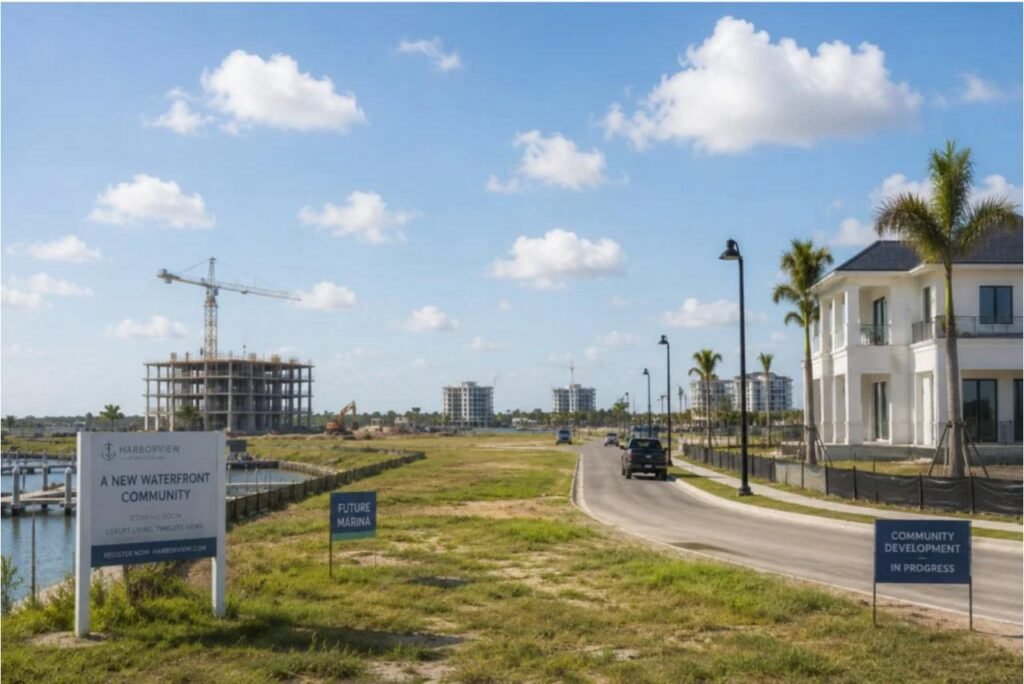
Three zones stand out for investors with a 3–5 year horizon:
Sangotedo and Ogombo (Ajah hinterland): Improved access via the Lekki-Epe Expressway, new estate developments, and spillover from Ajah’s rental market are driving rising rents with still-modest entry prices.
Oshodi and the Red Line Corridor: Transit-oriented demand is repositioning historically overlooked Mainland areas. Oshodi, in particular, has benefited from urban regeneration investment and now attracts a younger professional renter base.
Ibeju-Lekki: Land-focused play only for now. The rental market is thin, but land values near the Lagos-Calabar Highway corridor have appreciated 25–40% since construction began. Investors buying land here are not generating yield today; they are banking on infrastructure-driven appreciation over a five-plus-year horizon.
Frequently Asked Questions
What is the average rental yield in Lagos in 2026? Lagos residential rental yields average 4–7% gross across the city, with mid-market Mainland areas like Yaba delivering 7–9% and luxury Island locations like Ikoyi sitting at 3–5%. The city-wide gross average is typically quoted between 6–8% for mid-market zones.
Which area in Lagos has the highest rental yield? Yaba consistently delivers the highest gross rental yields in Lagos, typically 6–9% on 1 and 2-bedroom apartments. Maryland, Gbagada, and Surulere follow closely. The combination of high tenant demand from tech workers, lower entry prices than Island areas, and rising rents makes the Yaba cluster the strongest pure yield zone in the city.
Is Lekki a good investment for rental income? Yes, particularly for 2-bedroom apartments and short-let properties. Inner Lekki neighbourhoods like Osapa London and Lekki Phase 1 deliver 5–8% gross yields on long-let, and significantly more for furnished short-let operators targeting corporate and leisure travellers.
Why are rental yields in Ikoyi so low? Purchase prices in Ikoyi have appreciated far faster than rents. Luxury apartments can cost ₦500 million or more, but annual rents — while high in absolute terms — cannot justify those valuations on a yield basis. Ikoyi is a capital appreciation and prestige market, not a yield market.
Should I invest in the Island or the Mainland for rental income? For pure rental yield, the Mainland (particularly Yaba, Ikeja, and Maryland) wins. For a blend of income and capital growth, mid-Lekki and Ajah offer the best balance. The Island delivers lower yields but potentially higher resale values over time. Your choice should depend on your investment horizon, capital available, and whether you need current cash flow.
What property type generates the best rental yield in Lagos? Studios and compact 1-bedroom apartments generate the highest yield per square metre, often 1–2 percentage points above larger units. 2-bedroom apartments offer the best balance of yield and demand breadth. Large luxury units (4-bedroom apartments and houses in premium estates) typically generate the lowest yields because the purchase price is high relative to achievable rent.
Making Your Move
Lagos property rewards investors who know what they are buying. A ₦50 million apartment in Yaba and a ₦500 million apartment in Ikoyi can both be smart investments — but they are not the same investment. One is an income asset; the other is a capital asset. Treating them as equivalent because they are both in Lagos is the most common mistake we see first-time investors make.
If you are a yield-focused investor with a five-to-seven-year horizon and moderate capital, the Lekki-Ajah corridor and mid-Mainland zones like Yaba represent the most compelling entry points in 2026. If capital appreciation and wealth preservation are your primary goals, Prime Island remains Lagos’s most proven store of value.
At Salesvile Properties, we work across all of these zones and can help you identify the right asset for your strategy — not just the best-looking listing. Browse our current Lagos property listings or read our guide to the top Lagos real estate investment trends for 2026 to go deeper.
It depends on your objective. For the highest current rental yields in Lagos: Yaba and Ajah/Sangotedo. For balance of income and capital appreciation: Lekki Phase 1 and Ikeja GRA. For long-term capital growth with infrastructure catalysts: Ibeju-Lekki and the Lekki-Epe corridor. For short-let cash flow: Lekki, Victoria Island, and Ikoyi with professional management.