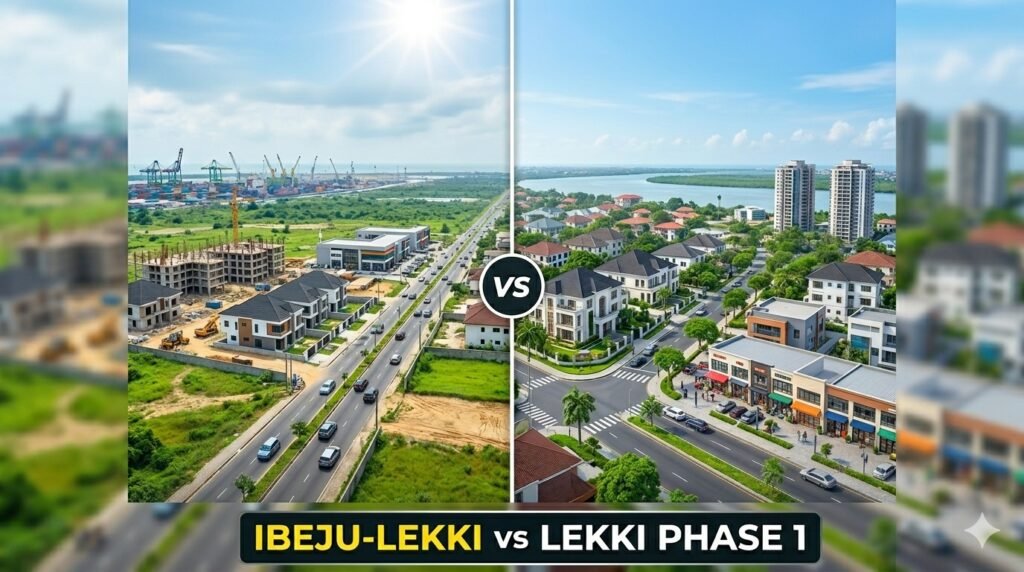
Ibeju-Lekki vs Lekki Phase 1 investment offers higher percentage returns for long-term land investors, while Lekki Phase 1 offers stability, immediate rental income, and lower risk for buyers who want a finished, livable property now. The right choice depends on your budget, your investment horizon, and whether you’re chasing capital appreciation or steady cash flow.
Both corridors sit on the Lekki Peninsula, Lagos’s most active property market, but they represent two very different investment philosophies. Lekki Phase 1 is a mature, fully built-up district with infrastructure, schools, and commercial activity already in place. Ibeju-Lekki is the emerging frontier, anchored by some of the largest industrial projects in West Africa and still in its growth phase. This guide breaks down the numbers, the risks, and the realistic return profiles for each, so you can decide which fits your investment goals.
Table of Contents
Lekki Phase 1: The Established Choice
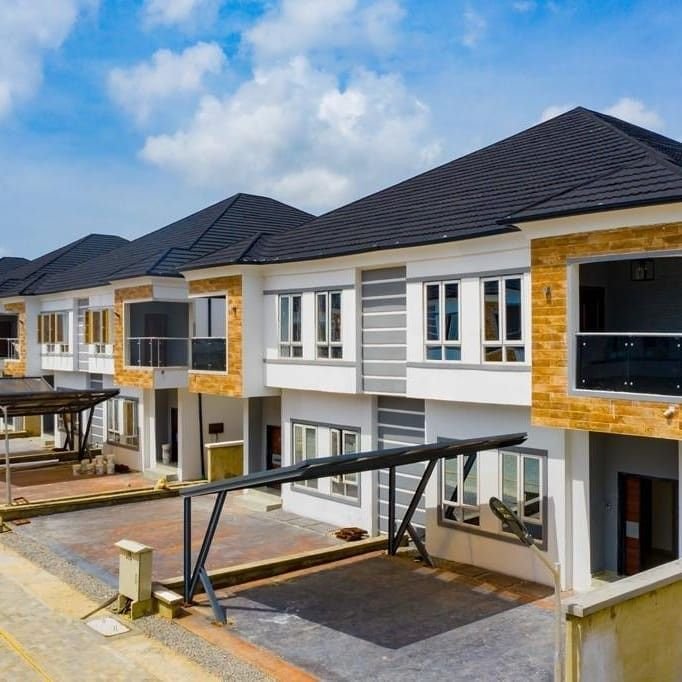
Lekki Phase 1 is one of Lagos’s most sought-after residential and commercial addresses, and that maturity is reflected directly in price. As of January 2026, land in this prime zone trades at roughly ₦1 million to ₦3.2 million per square metre, putting a standard 600-square-metre plot well into the hundreds of millions of naira.
That price tag buys you certainty. Roads, drainage, electricity, and security infrastructure are largely complete. Properties here can be rented out or occupied almost immediately, and the area’s status as a commercial and lifestyle hub means demand for housing remains consistently high. Lekki as a whole accounts for roughly 35% of all high-value land transactions across Lagos State, according to an analysis cited by Nigeria Property Centre, underlining how dominant the corridor remains in the city’s property economy.
The tradeoff is appreciation ceiling. Because Lekki Phase 1 is already built out, there’s limited room for the explosive percentage gains seen in newer corridors. Analysts note that Lekki’s infrastructure maturity makes it ideal for immediate occupation but limits the dramatic appreciation potential seen in less developed areas such as Ajah or Ibeju-Lekki. For investors, this translates to a lower-risk, lower-but-steadier-return profile.
Ibeju-Lekki: The High-Growth Frontier
Ibeju-Lekki has become the centre of gravity for industrial and infrastructure investment in Lagos. The area hosts the Lekki Free Trade Zone, the Dangote Industrial Complex, and the Lekki Deep Sea Port, which have collectively transformed what was once a quiet coastal corridor into one of the highest-demand land markets in Nigeria.
The price growth tells the story. Plots that sold for around ₦15 million in 2024 were commanding ₦25 million to ₦35 million by early 2026, according to transaction data tracked by a Lagos property firm covering over 30 verified sales. Some micro-locations have done even better. Properties within roughly 5km of the Dangote Refinery or Lekki Deep Seaport have seen appreciation of 800% to 1,000% since 2020, according to Shalom Park Estate data.
This growth is expected to continue, but on a longer timeline. Industry analysis from Adron Homes suggests Ibeju-Lekki will shift from a “frontier investment” to an “established growth market” sometime between 2027 and 2030 as infrastructure projects reach completion. Investors who buy strategically positioned land now could see substantial gains by the early 2030s, though this requires patience and a higher tolerance for short-term volatility.
Side-by-Side Comparison
| Factor | Lekki Phase 1 | Ibeju-Lekki |
| Entry price | High (₦1M–₦3.2M per sqm) | Lower (₦250K–₦500K per sqm in nearer zones) |
| Infrastructure | Mostly complete | Developing rapidly |
| Investment horizon | Short to medium term | Long term (7–10 years) |
| Return profile | Stable, moderate | Higher potential, more volatile |
| Rental income potential | Strong, immediate | Limited until development matures |
| Key growth drivers | Existing commercial activity | Dangote Refinery, Deep Sea Port, Free Trade Zone, new international airport |
Which One Should You Choose?

If your goal is immediate rental income, a place to live, or a low-risk asset in an established market, Lekki Phase 1 is the safer bet. The high entry cost is offset by liquidity, demand, and the fact that the area’s value is already largely realised and stable.
If your goal is capital appreciation over a 5 to 10 year horizon and you can afford to hold land without immediate income, Ibeju-Lekki offers a meaningfully higher upside. The key is due diligence: focus on land with verifiable titles, ideally Certificate of Occupancy or Government Allocation, and within proximity to confirmed infrastructure projects like the Dangote Refinery, the Lekki Deep Sea Port, or the planned international airport corridor.
Many seasoned investors don’t treat this as an either-or decision. A common strategy is to hold an established asset in Lekki Phase 1 for stability while allocating a smaller portion of capital to Ibeju-Lekki land for long-term growth.
Frequently Asked Questions
Is Ibeju-Lekki a good investment in 2026?
Yes. Ibeju-Lekki remains one of Lagos’s fastest-appreciating corridors due to ongoing infrastructure projects, but it suits investors with a longer time horizon rather than those seeking quick turnaround.
Why is land in Lekki Phase 1 so expensive?
Lekki Phase 1 is a fully developed, prime residential and commercial district with complete infrastructure and consistently high demand, which keeps prices among the highest in Lagos.
How much has land in Ibeju-Lekki appreciated in recent years?
Land bought in 2018 for around ₦1 million is now worth between ₦10 million and ₦15 million in some locations, with values expected to keep rising over the next decade as infrastructure matures.
Can I get rental income from property in Ibeju-Lekki right now?
Rental demand is forming in nearby corridors as workers relocate for industrial jobs, but in most parts of Ibeju-Lekki, rental income potential remains limited compared to Lekki Phase 1 until development progresses further.
What documents should I check before buying land in either area?
Always verify the title, whether Certificate of Occupancy, Governor’s Consent, or Government Allocation, confirm the land is free of encumbrances, and work with a registered real estate firm to conduct a site inspection before payment.